
Blog Post Book Club 1/2026
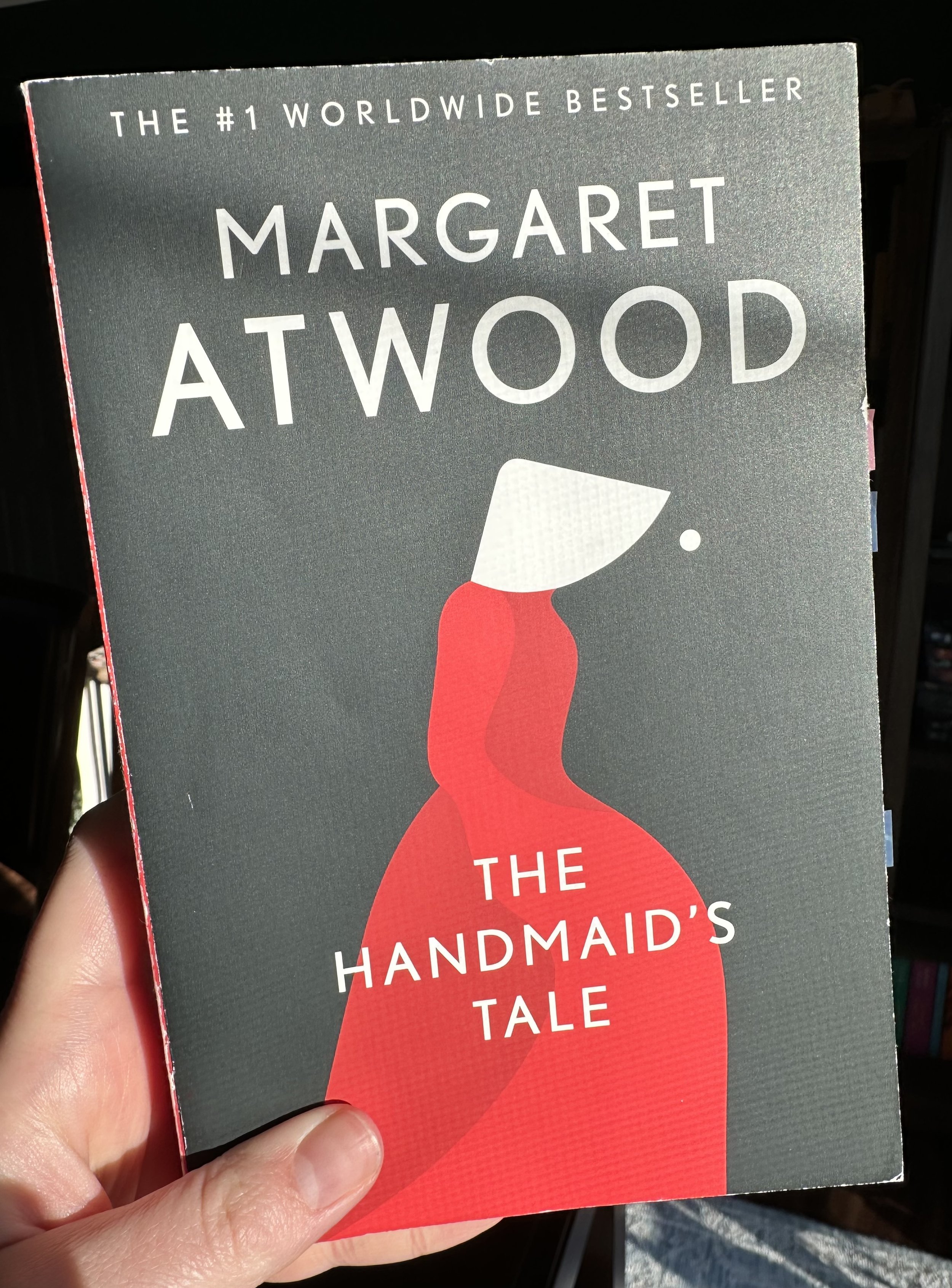
The Handmaid’s Tale
Margaret Atwood
*This post will contain spoilers for the book!*
Trigger Warning: Discussion about self-harm, death by suicide, sexual assault, and violence against African American, Jewish, and LGBTQIA+ individuals.
I am referencing the Vintage Books Edition, published in April 1998.
When I watched The Handmaid’s Tale TV series on Hulu, it became an instant favorite of mine. I was positively captivated! I began watching it as a 19-year-old college freshman, living at home during the COVID-19 Pandemic. I found out quickly that the show is based on a novel written by Margaret Atwood and felt like I had been living under a rock.
Years later, when I had the time and energy to return to my colossal reading list, The Handmaid’s Tale was right at the top. I craved a feminist novel to read, one where powerful women push against social structures that keep them in glass boxes barely big enough to stand in. Surprisingly, this is not what I found in The Handmaid’s Tale. Nevertheless, I loved it all the same.
Margaret Atwood and Her Work on The Handmaid’s Tale
I adore Margaret Atwood. I adore her process, her work, her thoughts, her activism... seriously, I think she is incredible.
Several of Atwood’s works have been banned in various settings (such as schools and public libraries) across the world for being too sexual, morally corrupt, anti-Christian, and overly political. To me, censorship via banning books does nothing but disservice communities—the books we should be reading are often the ones that make us uncomfortable. Atwood unapologetically continues to write the truths she sees, and protests the censorship her own work is often hidden behind.
In the case of The Handmaid’s Tale, Atwood gave herself the rule that all events, technologies, laws, and atrocities which are present in the novel must parallel real-world events and items which are already present in history. In other words, everything in the book is rooted in reality. It is not just fiction, it is history, too.
Atwood has firsthand experience living next door to totalitarianism; she began writing The Handmaid’s Tale while living in West Berlin in 1984, years before the fall of the Berlin Wall and even further from the fall of the USSR (p. XIII). She had visited the other side of the Iron Curtain, and “...experienced the wariness, the feeling of being spied on, the silences, the changes of subject, the oblique ways in which people might convey information...” (p. XIII), all of which informed her portrayal of totalitarianism in her novel.
Understanding all of this makes reading The Handmaid’s Tale more haunting, more jarring.
Plot Overview
It is popularly thought that the narrator’s name in The Handmaid’s Tale is June. Since that has not been confirmed, I will be referring to the main character as “the narrator” or Offred. This is a personal preference; you are welcome to call her June in the comments if you wish!
The Handmaid’s Tale takes place in the fictional Republic of Gilead, a totalitarian theocratic regime which has almost entirely replaced the United States of America, across three timelines: present day, post-capture in the Red Center, and before Gilead. The narrator, known as Offred, is a Handmaid.
Handmaids are assigned to households of Commanders who cannot conceive their own children with their wives. The narrator is assigned to Fred and Serena Joy Waterford’s household. Serena Joy is a former gospel singer and advocate for traditional values who once had a successful career and a large platform for spreading her message. Serena Joy is clearly bitter about her relegation to trapped housewife, and often takes her frustration out on Offred. Atwood also implies that Serena Joy is bitter about being forced to take a Handmaid in her home to try to conceive, leading to further resentment towards the narrator.
Once per month, when Offred is at peak fertility, she is required to participate in a ritual called “The Ceremony” where she and the commander have sexual intercourse in an attempt to become pregnant. While this is happening, Offred is laying between Serena Joy’s legs as Serena Joy sits behind her, holding her wrists in a death grip.
Most of the novel’s contents walk readers through the narrator’s highly restrictive daily life, including daily shopping trips with her partner, Ofglen. During these walks, they often visit the Wall, where bodies of rebels are strung up and displayed. Eventually, the Commander begins inviting Offred to join him in his study, where they play Scrabble, and Offred is given old fashion magazines to look through. These things are both forbidden, since women are not allowed to read or write. After their meetings in the study, the commander asks Offred to kiss him. Again, this is forbidden.
On a shopping trip, Ofglen tells the narrator she is a member of a rebel group called Mayday. She asks the narrator to attempt to collect information from Commander Waterford that the group can use. As they are talking, two secret police members (Eyes) snatch a man from the sidewalk in front of them. Everything continues on like normal once the van starts moving again.
The narrator never does become pregnant with the Commander’s child, so Serena Joy arranges for the narrator to sleep with Nick, the Waterfords’ driver. Atwood alludes to the Commander being sterile, and should Offred fail to become pregnant, she will likely be taken to a death camp (the Colonies) as a consequence. The narrator agrees to Serena Joy’s request and goes to Nick’s room. Serena Joy shows Offred a picture of her daughter from before Gilead as a reward, revealing that she has known where Offred’s daughter is the whole time they’ve known each other.
After this, the narrator and Nick enter into a full-blown affair, meeting repeatedly for sex. The narrator becomes so absorbed in the secret affair that she becomes reckless and apathetic, ignoring Ofglen’s request for information.
During one secret meeting with the Commander, he gives the narrator a revealing outfit to wear, has her put on makeup, and takes her to a club called “Jezebel’s” where commanders and other men engage with sex workers, sent to the club in place of the Colonies. Here, the narrator reunites with her best friend, Moira, who is working in the club. After leaving Moira, she goes to an old hotel room with the commander where they have sex.
Eventually, Offred realizes a new Ofglen has taken the place of the one she knew. The new Ofglen reveals that the previous one ended her life when she realized the Eyes were coming for her. The new Ofglen subtly warns Offred against trying to contact Mayday again.
Later, Offred is in her room when a black van belonging to the Eyes pulls into the driveway. Nick tells her she will be fine, the Eyes coming are a part of Mayday, and instructs her to go along with them. The story ends with Offred stepping into the van.
Throughout the events of the present, the narrator slips into flashbacks showing her husband, Luke, her daughter, Hannah, her best friend, Moira, and her mother. We learn that her husband was married to another woman when they met. Luke proceeded to cheat on his wife with the narrator, leaving the narrator with the title of “Adulterer,” eventually securing her position as a Handmaid. Luke leaves his wife, marries the narrator, and they have a daughter together named Hannah.
The narrator recounts moments from her past and events from the overthrowing of the United States government. A group assassinated the president, killed the members of congress, and had their army declare a temporary state of emergency. During that time, several rights were subtly taken from women, including the ability to work and have a bank account. The narrator recounts the new order’s military open firing on crowds once any marches or protests started. Following this, the country spiraled quickly into the oppressive Republic of Gilead.
My Thoughts
Immediately, the tone is unsettling. Atwood juxtaposes the narrator’s memories of similar places with the eerie current-day setting: school dance decorations versus rows of army cots, separated so their occupants can’t speak across the gaps. Both transform the space, and both hold some sort of anticipation for what will come next.
This sort of juxtaposition—placing a common experience in many people’s pasts with the book’s current-day setting—is one method Atwood uses to connect readers to the characters’ experiences. Part of what makes the opening scene feel so eerie is imagining my own high school gymnasium or common area transformed into a “Red Center.” Instead of teachers, there are Aunts armed with cattle prods and guards armed with guns. The outside of the facility is enveloped in a guarded chain link fence topped with barbed wire. The scene looks more like a prison than a school.
There is also an immediate sense of desperation and fear. Atwood deliberately points out that the basketball hoops are still connected to the backboards, but they are missing nets. My thoughts immediately went to self-harm and suicide; the enforcers of the regime are taking away the women’s ability to take control of their situation by ending their lives.
This theme is repeated throughout the book. At several points, Atwood clearly calls out all of the abnormal things in the setting which are present (or not present) to prevent desperate people from being able to harm themselves. The acknowledgement of women’s desires to end their lives is chilling to me, especially since the conditions they are living in do not improve. The removal of any device or tool which could be used to achieve this suggests the regime’s leadership is more concerned with losing their servants and human livestock than with creating habitable situations for the people they oppress. Atwood frequently points out these missing or adjusted elements of the setting, keeping them at the forefront of readers’ minds as they move through the story.
There is also a significant disconnection between the decision-makers and the people who live with the laws they create. On pages 158 and 159, Atwood calls out the Commander’s ignorance to the conditions the regime’s subjects live under. Offred asks him for some hand or face lotion because her skin gets dry, and lotion is not available as it promotes vanity and self-absorption. He obliges and tells her to keep the small bottle in her room, to which she replies, “They’d find it,” alluding to the organized searches of the Handmaids’ rooms. The Commander is genuinely surprised, he was entirely unaware that the Handmaids’ rooms are searched for contraband on a regular basis.
He is one of the top decision-makers. He should be aware of the conditions under which the people of Gilead, especially Handmaids and Marthas, live. He has a Handmaid and two Marthas living in his home, yet he is completely ignorant of the goings-on in their everyday lives or the harsh treatment they face at the hands of nearly everyone they meet. The commanders will readily make laws oppressing women, but they have never once lived the life of a woman, nor will they ever. They will never need to heed the rules they set and clearly do not exercise empathy or consideration for the women they oppress as they make their decisions.
The violence and aggression between women in the novel is surprising, too. There is a clear power hierarchy in Gilead, and while the women have little to no power in their overall situations, there is a hierarchy that exists between them. Women with power over others gladly exercise it when they deem necessary. Aunts use cattle prods, wives hit with their hands, and both are verbally abusive to the Handmaids. Wives have the power to banish Handmaids to their rooms indefinitely, and may call upon them like servants whenever they wish. The women at the top are given leave to abuse the women at the bottom and often do.
Atwood’s never intended for women to be absolved of moral choice in The Handmaid’s Tale. Instead, she uses Gilead’s hierarchical structures to demonstrate that people will exercise control over one another, even when the collective power of the group is scant—in this example, women towards other women (XVI). Serena Joy’s character is the best example of this idea; she was once a woman with a platform, an activist who spoke in favor of Gilead’s ideology, an author whose thoughts were heard and acknowledged. Now, she is condemned to being nothing more than a wife who can no longer speak out of turn, write her opinions, or read her own book. She is a bitter character who eagerly grasps at any scrap of power she can find, often using said power to subjugate and abuse the women assigned to work in her household.
It is not only women who are oppressed under this regime; no review or analysis would be complete without acknowledging the displacement of or complete erasure of the LGBTQIA+ community, Black Americans, and Jewish Americans in Gilead. In the book, it is done citing biblical precedent (as are the other atrocities committed). Erasure and removal of unwanted populations in totalitarian regimes have repeatedly been seen in world history. The Holocaust and the Holodomor are two very real examples of similar behavior across separate times in different places.
People of other religions or who oppose the regime in any capacity are labeled heretics and radicals while the people who are uprooting and overturning the lives of everyone in the former United States are called angels. Propaganda is a common tool used in totalitarian regimes, employed to indoctrinate as many as possible and make atrocities appear as kind acts being done for the good of all (especially when “all” excludes several groups in the population). Atwood beautifully calls attention to this language, and often challenges it through her narrator’s commentary of her surroundings.
What surprises me the most is the narrator’s apathy towards her situation and the potential of escape. I watched the TV series before reading the book and expected the book’s Offred to be a revolutionary hellbent on finding her way out of Gilead. In practice, the book’s Offred is resigned to her place, having accepted that she is stuck and will likely be in Gilead until the day she dies. There are small moments of hope, and she practices some acts of defiance against those in power (like indulging in her illicit affair with Nick), but she ultimately does not actively attempt to push back against Gilead itself. When she is given an opportunity to via her relationship with Ofglen, she remains apathetic and does not move to take the action asked of her. The narrator’s inaction and apathy are often contrasted by flashbacks featuring her mother, who was an avid activist, frequently practiced civil disobedience, and participated in organized demonstrations.
Ultimately, Atwood confirms that the narrator’s mother was sent to the Colonies and is most likely dead. Her death highlights the futility of disobedience under such a regime. Often, it is met with indiscriminate violence and is stamped out before it is given a chance to grow. Overall, Atwood’s novel gives readers a window into the oppression of totalitarianism. Knowing that all events in The Handmaid’s Tale have been pulled from history gives the story an eerie sense of possibility. History often repeats itself, which has been proven time and time again. The Handmaid’s Tale calls us to remember this as we read: remember the story, lest we repeat it again.
Next Month’s Pick: Beloved by Toni Morrison
This book is incredible. It is devastating while being so beautiful to read, hopeless and hopeful at the same time. I deeply respect Toni Morrison and adore her work, she is a wildly accomplished author who has received several high honors and awards for her outstanding work, including the 1993 Nobel Prize in Literature. Beloved received the 1988 Pulitzer Prize for Distinguished Fiction.
*Please be aware, this book tackles the topic of slavery in the years immediately leading up to, during, and after the American Civil War. All of the main characters are former slaves, and as such, they survive some deeply disturbing, horrible events.